Biography of Susan Wester Perez
HER LIFE
A native of New York City, Susan and her family moved several times when she was a child. Her father was a Fund Raising Consultant, and there was always a new project in another place. They lived in New York, New Jersey, Tennessee, and California, before settling down in Newton, Massachusetts.
Susan enrolled in art classes wherever she could. She felt at home in art. All through middle school and high school she was lucky enough to have inspiring teachers and supportive parents who believed in her and encouraged her artistic pursuits. After high school, Susan studied Design, Painting, and Literature at The University of Massachusetts in Amherst, and later at Massachusetts College of Art in Boston.
As a young adult, Susan became restless. She needed change and a reset. Moving to Los Angeles, California, she was hired at an art supply store and gallery. The Art Stores were a small chain of stores up and down the California coast. There she met a fellow artist and photographer, from Mexico City and raised in El Paso, Texas and something clicked. Although their backgrounds were very different, they shared a passion for art and they pledged to support and encourage each other to keep creating.
Fast forward a number of years and they are 33 years married and living and working in El Paso, Texas. Jerry is pursuing his photography, expanding out from birds to the landscapes and landmarks that make this city so unique and uniquely beautiful. Susan documents her life and paints the landscapes, objects and people that she finds in her life at the border.
El Paso rests at the intersection of Mexico, Texas, and New Mexico, There is a "flavor" to this part of the world and it's not just the food. It's both sweet and salty. The Chihuahan desert has a harsh dryness to it and yet produces the most luscious flowers. They even celebrate the dead here.
Dia de los Muertes is a cultural holiday that Susan embraces because it goes against the culture she grew up in, where death was never discussed. She often uses some of death's imagery in her art, sometimes in your face and other times just the earrings. Partying with the dead is not an attempt at denial but rather a declaration and an acknowledgement of death's inevitability, not fearing it but instead, embracing and celebrating it. This celebration robs death of some of it's power over people's lives. It allows you to have a sort of continuation of your relationship with your loved and departed ones. Amor Eterno.
FOLLOW SUSAN on Instagram @susanwesterperez, where you can see the freshest new art along with other snipets of her life as an artist. Also look for new openings and festivals that I will be participating in. If you've read til the end of this TY<3
HER PROCESS
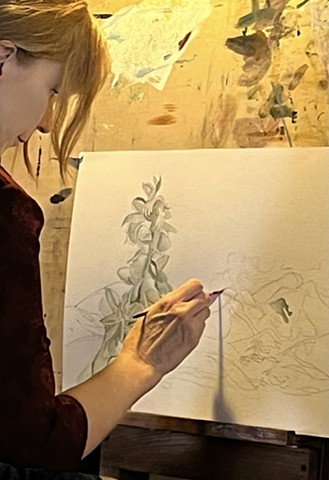
Her process typically starts with a watercolor or pencil sketch onto paper, mapping out the thrust of the composition.
“I need to understand a subject before I feel ready to paint it.” Susan says, “And that can entail anything from consulting photos and making preliminary sketches, checking wherever for research and context. Only when I understand it can I begin to paint it.”
Typically, her next step is a base layer. Using washes of color she maps out different planes and surfaces, letting that fully dry before moving on.
“There is a transformation that takes place when watercolor dries” she explains, ”patterns and textures appear in the paper, where color has settled into tiny pools on the paper. This makes some areas darker and richer while others are filled with light.” Susan takes cues from this natural process, and strives to incorporate them into the final composition whenever possible
Her color palette is filled with saturated colors and often opposite colors share edges, making them even stronger and more vibrant. She calls this technique “making the colors sing.”
Layering of colors is another feature of her work. The transparency of the water media can give a painting a stained-glass effect when dark colors are placed over light. However, Susan will also layer light colors over dark, breaking a cardinal rule of watercolor, when she wants her piece to have a strange glow.
When different textures and/or opacity are needed, other media may be added as the final touch to a piece, such as pastel, pencil, ink, acrylic and gesso.